ServicesWell Water Treatment
Well Water Treatment in Racine
Rust-colored rings in the tub, a sulfur odor at the faucet or sand caught in the faucet screens point to iron, hydrogen sulfide or sediment in your well. We choose equipment for what your water carries and what your pump can deliver, then schedule the install around your budget.
What well water treatment fixes
A private well delivers whatever the ground puts into it. In southeast Wisconsin that often means dissolved iron, manganese, hydrogen sulfide gas and hardness minerals. Each one causes a different problem and needs a different fix, so a single generic filter rarely solves everything.
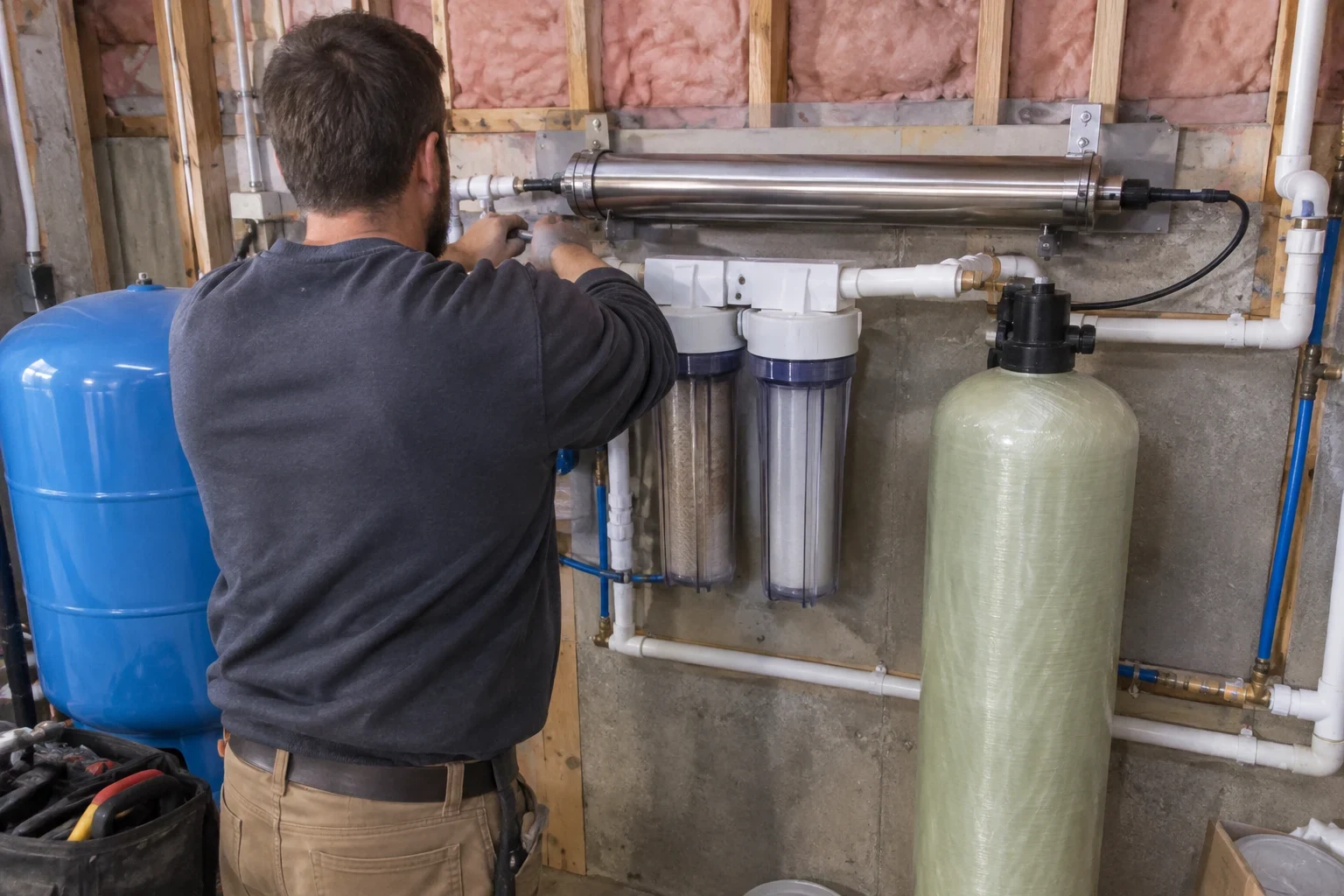
Our job is to pick the right stages and put them in the right order. Sediment comes out first so it cannot clog the media downstream. Iron and sulfur are oxidized and trapped next. Softening, if your water needs it, comes last so the resin is not fouled by iron it was never built to handle.
Most well owners in Caledonia, Yorkville, Raymond and the surrounding towns notice problems slowly. Stains build up, a fixture fails, the softener stops keeping up. Planning the work while it is still a nuisance lets you choose equipment and timing instead of replacing a water heater or pump first.
What the work includes
Sediment prefiltration
A spin-down screen or cartridge housing right after the pressure tank catches sand and scale before it reaches valves and media beds. It is the cheapest stage to maintain and protects everything after it.
Iron and manganese filters
An air-injection oxidizing filter uses a pocket of air at the top of the tank to turn dissolved iron into particles, which the media bed traps. The control valve backwashes the bed on a schedule to flush that iron to the drain.
Sulfur odor removal
The same air-injection design handles most hydrogen sulfide. Where the smell is strong, we may add a chlorine or peroxide feed ahead of a carbon tank to finish the job.
Softening after iron removal
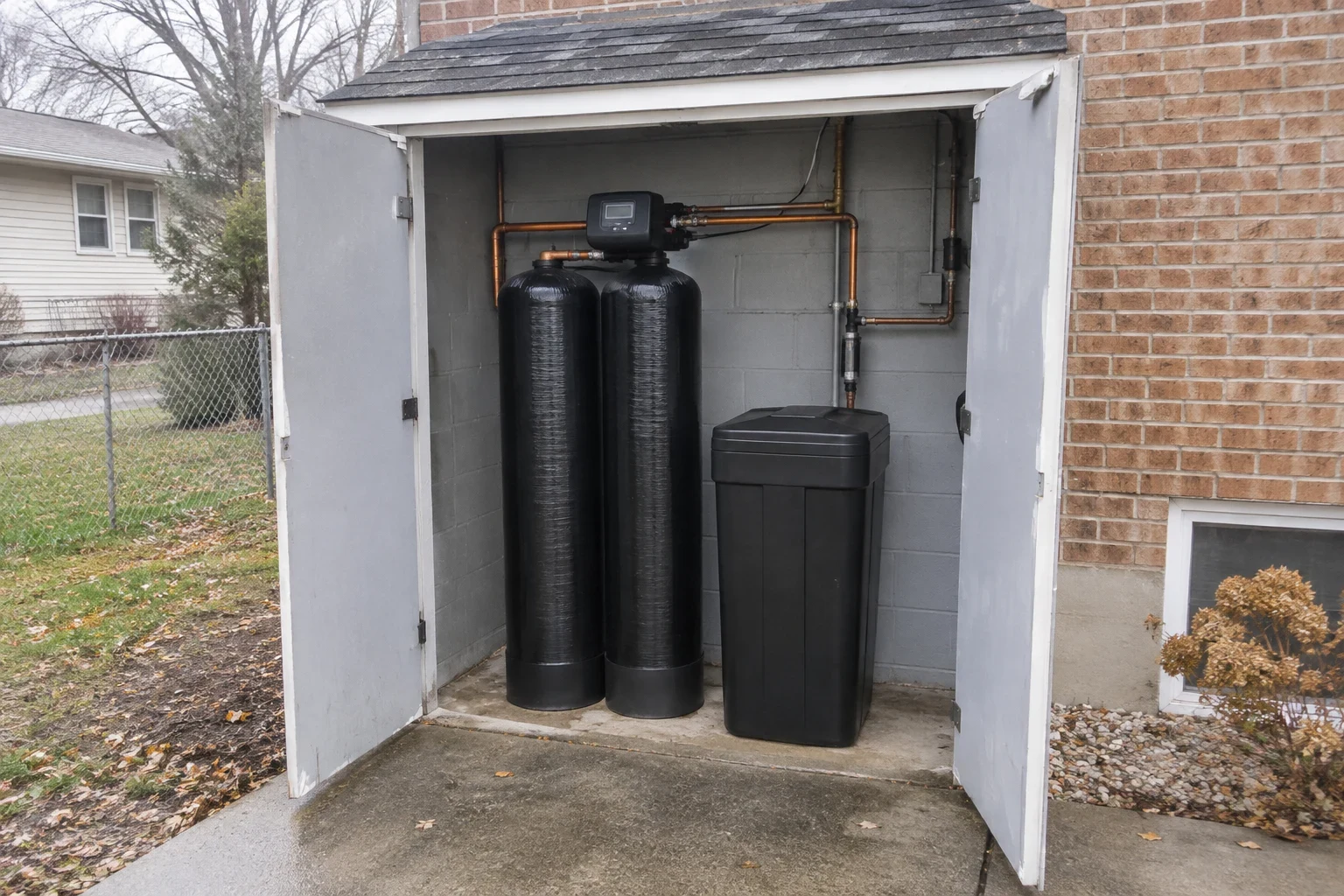
Hard well water leaves scale in water heaters and on fixtures. We size the softener for the water left after the iron filter, which keeps the resin cleaner and longer-lived. Our Water Softeners page covers the details.
Drinking water polish
For the kitchen tap, an under-sink unit covered on our Reverse Osmosis page can sit at the end of the line as a final stage.
Signs your well water needs treatment
Orange or rust-brown stains
Ferrous iron is clear coming out of the tap and turns orange once it meets air. Stains in toilets, tubs and laundry are the most common sign.
Rotten egg smell
Hydrogen sulfide gas has that smell. If it is only on the hot side, the water heater's magnesium anode rod may be reacting with sulfate in the water rather than the well itself.
Black specks or gray stains
These usually point to manganese, which often travels with iron and needs the same kind of oxidizing filter.
A softener that stopped keeping up
Iron coats softener resin and blocks it from grabbing hardness minerals. Hard water returning after a few years often means the softener is doing an iron filter's job.
Slime in the toilet tank
A reddish, jelly-like film is iron bacteria. It feeds on dissolved iron and can foul filters quickly, so we plan for it in the treatment design.
How a well treatment job runs
- 1
Phone call and free quote
We start with what you are seeing, your well setup and any lab results you already have. From there we lay out the stages that fit and give you a written quote, which holds for 30 days.
- 2
Site check of the equipment space
We look at the pressure tank, the incoming line, the nearest floor drain or standpipe and the electrical outlet. Backwashing filters need a drain and power, and they need room for service.
- 3
Install day
We shut off the pump, tie the new stages in after the pressure tank, add bypass valves so each unit can be isolated, and run the drain line. Water is usually off for part of the day.
- 4
Startup and walkthrough
We fill and backwash each tank, set the regeneration schedule and show you the bypass and how to read the control valve. Payment is due in full when the install is complete.
What moves the cost of well treatment
Your price comes down to what your well water carries and how many stages it takes to remove it. Iron on its own is a simpler job than iron mixed with sulfur, hardness and iron bacteria. Every stage gets its own line on the quote, so you can phase the work over time if that fits your budget better. Paying over time is also an option: financing is available through U.S. Bank Avvance, on approved credit.
- Number of treatment stages
- Each contaminant may need its own tank or chemical feed. More stages mean more equipment and more plumbing.
- Pump flow rate
- A backwashing filter needs a minimum gallons-per-minute to lift and clean its media bed. A weak pump can push us toward a larger tank or a different filter design.
- Space, drain and power
- A basement with a nearby floor drain is straightforward. A long drain run, a crawlspace or a garage that needs freeze protection adds labor.
- Removing old equipment
- Pulling out a fouled softener or an undersized filter, and replumbing around it, adds time to the install.
Common questions about treating well water
Something not covered here? (262) 829-5983
I already have a softener. Do I still need an iron filter?
If your iron level is low and the iron is still dissolved, a softener may cope with it for a while. At higher levels the iron coats the resin beads, and the softener slowly loses its ability to remove hardness. Putting an iron filter in front takes that load off the resin, and both units tend to last longer as a result.
Will the treatment lower my water pressure?
Every stage adds some pressure drop. We size tanks and valves to your plumbing and pump flow so the drop stays small at normal household use. Clogged sediment cartridges are the most common cause of pressure loss later, which is why we show you how to change them.
Where does the backwash water go?
It runs through a drain line to a floor drain, laundry standpipe or sump, with an air gap so it cannot siphon back. The flushed iron and sulfur go with it.
How much upkeep does an iron filter need?
Air-injection filters regenerate on their own with no chemicals. You will change the sediment cartridge, and the media bed is replaced after several years depending on how much iron it handles. Chlorine or peroxide feed systems need the solution tank refilled.
What if I change my mind after signing the quote?
You have three business days after you sign to cancel. That gives you time to go back over the quote and any financing terms without pressure, before the install date is set.
Plan your well treatment before the next repair
Describe the stains, odors or pressure changes in your home, and we will map out which stages you need, the order they go in and what each one costs. The quote holds for 30 days, so you can schedule the install when it fits your calendar.